




Summary:
- Anesthesiology is moderately competitive, in part due to having so many programs and positions available
- In part due to the volume of applications, anesthesiology residency programs use standardized screens to “weed out” applicants
- The most successful applicants won’t fail any USMLE, have good USMLE scores, a stellar MSPE, and demonstrate lots of interest in programs
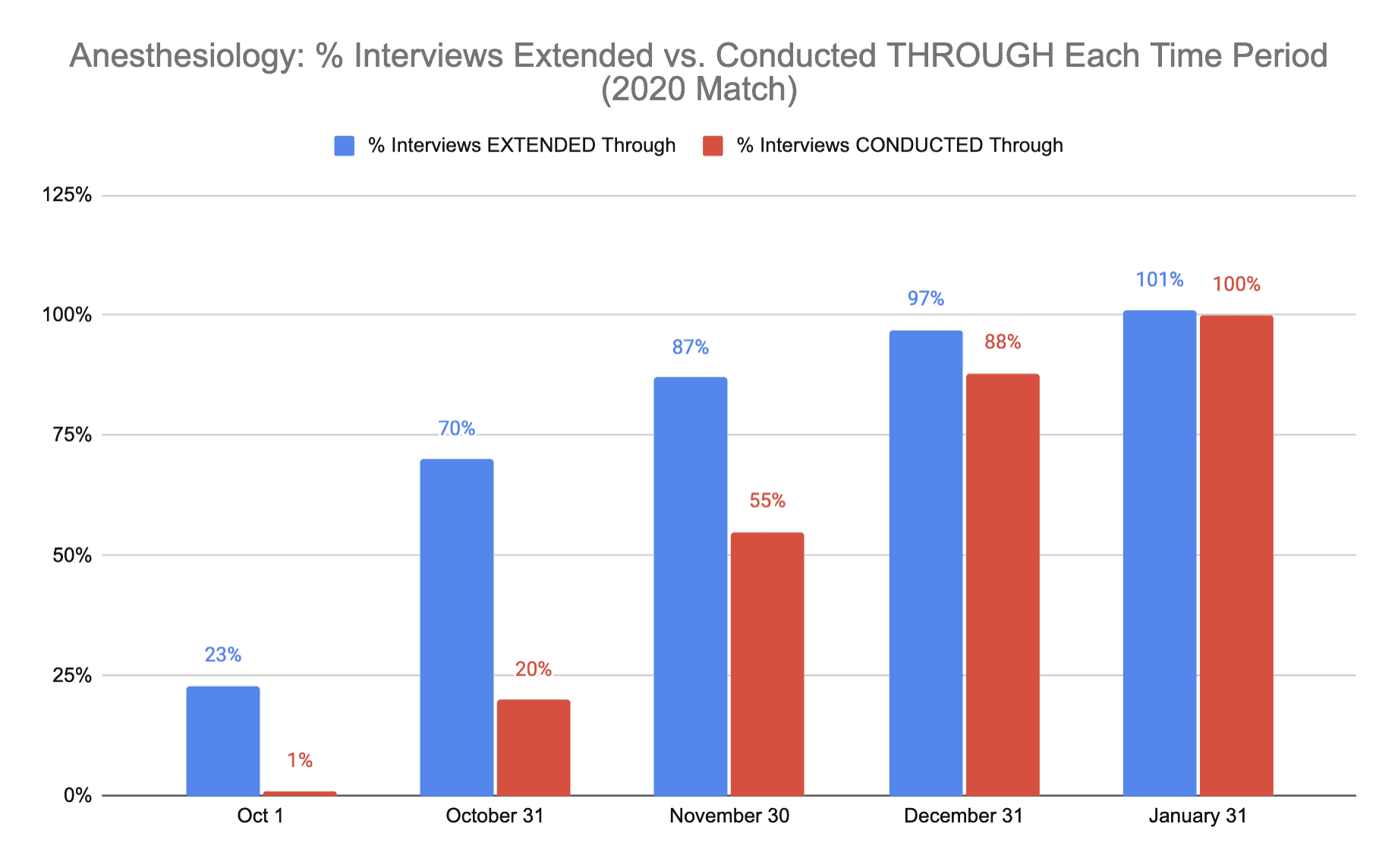
- Historically, most anesthesia interview invites occur before October 31, and the vast majority before November 31
Table of Contents
How Competitive is it to Match into Anesthesiology?
How competitive is it to match into anesthesiology in the US? Here we have the unmatched % for US seniors by specialty. The “Unmatched %” means the % of US seniors who applied into anesthesiology who did not match during the given year. This is one measure of specialty competitiveness – perhaps the most relevant if you want to match into anesthesiology.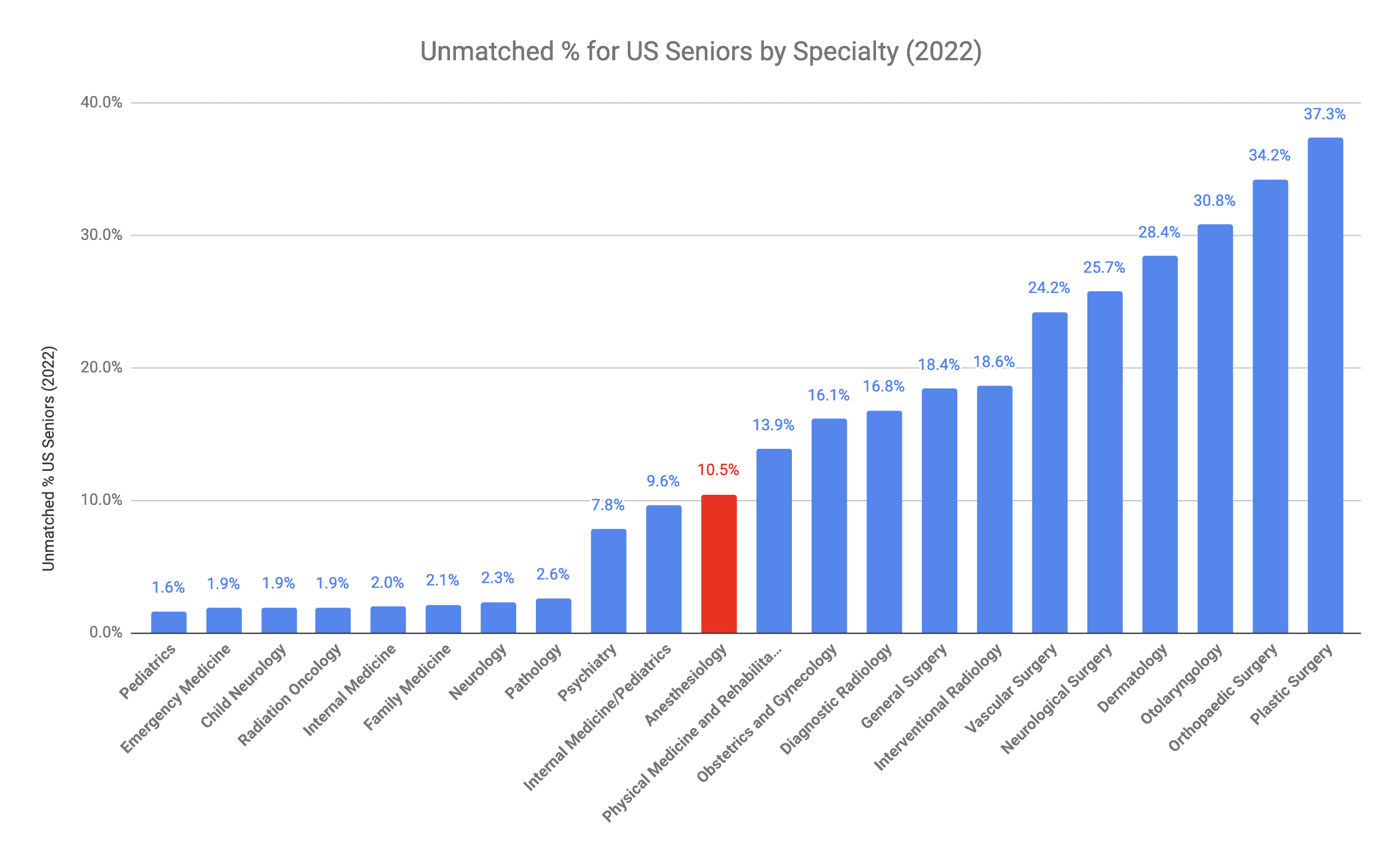 For more on the competitiveness of anesthesiology relative to other medical specialties, see this article.
How Many Anesthesia Residency Programs Are There?
Before we discuss how many anesthesia residency programs there are in the US, let’s review some terminology. For many specialized residency programs (e.g., anesthesiology, dermatology, radiology, radiation oncology, etc.), the specialty training begins during their second year of residency. This second year is also known as the PGY-2 (post-graduate year 2, for the second year after graduating from medical school).Categorical vs. Advanced vs. Physician Anesthesiology Programs
Anesthesiology has three different kinds of residency programs applicants can potentially enter: categorical, advanced, and physician (R). Categorical refers to programs that include all years of residency training. Anesthesiology residency lasts four years. The first year of training, however, is a “preliminary” year that can be either internal medicine, surgery, or transitional (a sort of grab-bag that will depend on the hospital). Some programs include the PGY-1 “intern” year – these programs are known as “categorical” programs. Others, however, require applicants to match separately into an intern year. These programs, which begin in the PGY-2 years, are referred to as “advanced” positions. Finally, for others who have already completed at least a year of residency training, they may be eligible for a “physician” anesthesiology position. These positions allow applicants to move directly into the PGY-2 specialty training and skip the PGY-1 year. This arrangement may be ideal for those who want to complete residency sooner and not have to repeat their intern year.How Many Anesthesia Residency Programs and Positions Are There?
In the 2022 NRMP Match, there were:- 165 anesthesiology programs offering 1,509 PGY-1 (categorical) positions,
- 58 anesthesiology programs offering 346 PGY-2 (advanced) positions, and
- 55 anesthesiology programs offering 114 Physician (R) positions
How to Match into Anesthesiology: Impressing Program Directors
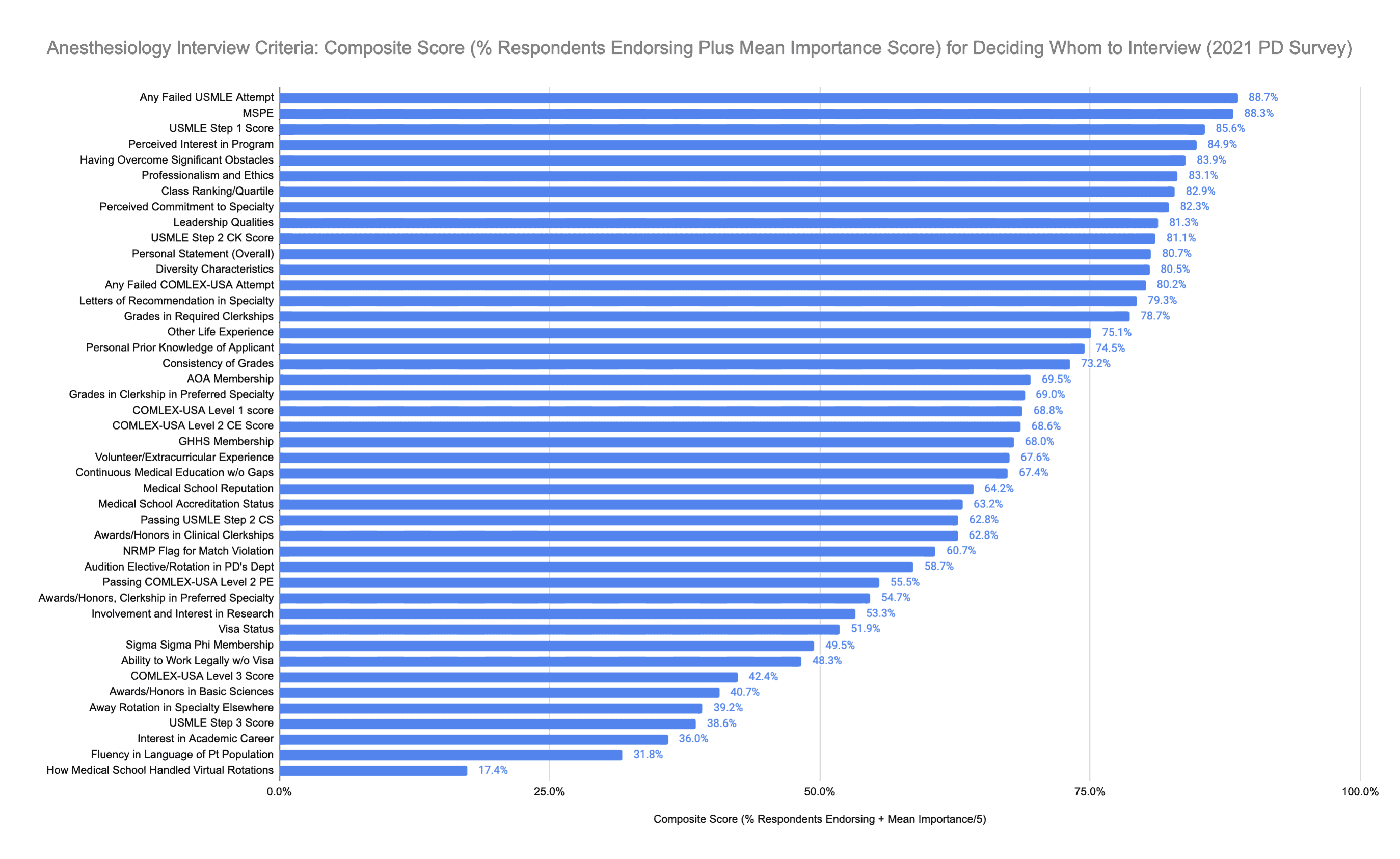
To match into anesthesiology, you must first be invited to interview. According to the most recent program director (PD) survey from 2021, PDs shared what they look for in candidates they hope to interview. For anesthesiology, the top five most important characteristics for receiving an interview, according to program directors, were:- Any failed USMLE attempt
- MSPE
- USMLE Step 1 score
- Perceived interest in program
- Having overcome significant obstacles
| Anesthesiology: Characteristics Considered in Deciding Whom to INTERVIEW (% of Respondents Endorsing) | Anesthesiology: Characteristics Considered in Deciding Whom to INTERVIEW (Mean Importance / 5) | Anesthesiology: Characteristics Considered for Interview Composite Score (Average of % Respondents Endorsing and Mean Importance / 5) | |
|---|---|---|---|
| Any Failed USMLE Attempt | 83.3% | 4.7 | 88.7% |
| MSPE | 90.5% | 4.3 | 88.3% |
| USMLE Step 1 Score | 95.2% | 3.8 | 85.6% |
| Perceived Interest in Program | 85.7% | 4.2 | 84.9% |
| Having Overcome Significant Obstacles | 85.7% | 4.1 | 83.9% |
| Professionalism and Ethics | 76.2% | 4.5 | 83.1% |
| Class Ranking/Quartile | 85.7% | 4 | 82.9% |
| Perceived Commitment to Specialty | 78.6% | 4.3 | 82.3% |
| Leadership Qualities | 78.6% | 4.2 | 81.3% |
| USMLE Step 2 CK Score | 88.1% | 3.7 | 81.1% |
| Personal Statement (Overall) | 83.3% | 3.9 | 80.7% |
| Diversity Characteristics | 81.0% | 4 | 80.5% |
| Any Failed COMLEX-USA Attempt | 64.3% | 4.8 | 80.2% |
| Letters of Recommendation in Specialty | 78.6% | 4 | 79.3% |
| Grades in Required Clerkships | 83.3% | 3.7 | 78.7% |
| Other Life Experience | 76.2% | 3.7 | 75.1% |
| Personal Prior Knowledge of Applicant | 69.0% | 4 | 74.5% |
| Consistency of Grades | 64.3% | 4.1 | 73.2% |
| AOA Membership | 69.0% | 3.5 | 69.5% |
| Grades in Clerkship in Preferred Specialty | 61.9% | 3.8 | 69.0% |
| COMLEX-USA Level 1 score | 59.5% | 3.9 | 68.8% |
| COMLEX-USA Level 2 CE Score | 57.1% | 4 | 68.6% |
| GHHS Membership | 61.9% | 3.7 | 68.0% |
| Volunteer/Extracurricular Experience | 57.1% | 3.9 | 67.6% |
| Continuous Medical Education w/o Gaps | 54.8% | 4 | 67.4% |
| Medical School Reputation | 52.4% | 3.8 | 64.2% |
| Medical School Accreditation Status | 52.4% | 3.7 | 63.2% |
| Awards/Honors in Clinical Clerkships | 59.5% | 3.3 | 62.8% |
| Passing USMLE Step 2 CS | 47.6% | 3.9 | 62.8% |
| NRMP Flag for Match Violation | 21.4% | 5 | 60.7% |
| Audition Elective/Rotation in PD's Dept | 33.3% | 4.2 | 58.7% |
| Passing COMLEX-USA Level 2 PE | 31.0% | 4 | 55.5% |
| Awards/Honors, Clerkship in Preferred Specialty | 33.3% | 3.8 | 54.7% |
| Involvement and Interest in Research | 40.5% | 3.3 | 53.3% |
| Visa Status | 35.7% | 3.4 | 51.9% |
| Sigma Sigma Phi Membership | 31.0% | 3.4 | 49.5% |
| Ability to Work Legally w/o Visa | 28.6% | 3.4 | 48.3% |
| COMLEX-USA Level 3 Score | 4.8% | 4 | 42.4% |
| Awards/Honors in Basic Sciences | 21.4% | 3 | 40.7% |
| Away Rotation in Specialty Elsewhere | 14.3% | 3.2 | 39.2% |
| USMLE Step 3 Score | 7.1% | 3.5 | 38.6% |
| Interest in Academic Career | 11.9% | 3 | 36.0% |
| Fluency in Language of Pt Population | 9.5% | 2.7 | 31.8% |
| How Medical School Handled Virtual Rotations | 4.8% | 1.5 | 17.4% |
What Do Anesthesiology Program Directors Look for When Ranking Applicants?
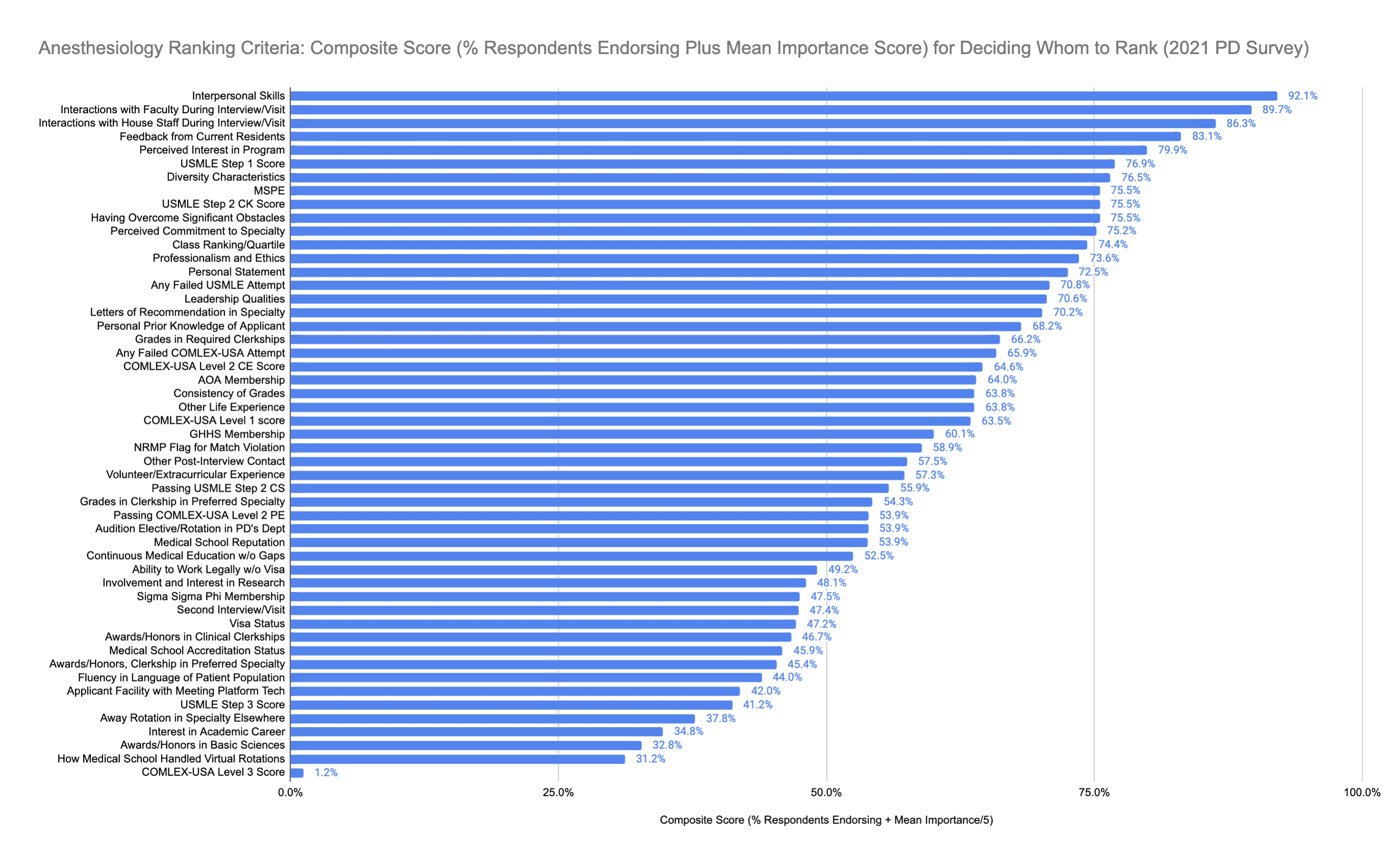
Getting an interview is only part of the process of matching into anesthesiology. Program directors also rank the most important factors for creating their rank order list. In the 2021 Program Director Survey, anesthesiology PDs rated these criteria as most important for deciding whom to rank:- Interpersonal skills
- Interactions with faculty during interview/visit
- Interactions with house staff during interview/visit
- Feedback from current residents
- Perceived interest in program
| Anesthesiology: Characteristics Considered in Deciding Whom to RANK (% of Respondents Endorsing) | Anesthesiology: Characteristics Considered in Deciding Whom to RANK (Mean Importance / 5) | Anesthesiology: Characteristics Considered for Rank Composite Score (Average of % Respondents Endorsing and Mean Importance / 5) | |
|---|---|---|---|
| Interpersonal Skills | 88.1% | 4.8 | 92.1% |
| Interactions with Faculty During Interview/Visit | 83.3% | 4.8 | 89.7% |
| Interactions with House Staff During Interview/Visit | 78.6% | 4.7 | 86.3% |
| Feedback from Current Residents | 76.2% | 4.5 | 83.1% |
| Perceived Interest in Program | 73.8% | 4.3 | 79.9% |
| USMLE Step 1 Score | 73.8% | 4 | 76.9% |
| Diversity Characteristics | 69.0% | 4.2 | 76.5% |
| MSPE | 69.0% | 4.1 | 75.5% |
| USMLE Step 2 CK Score | 69.0% | 4.1 | 75.5% |
| Having Overcome Significant Obstacles | 69.0% | 4.1 | 75.5% |
| Perceived Commitment to Specialty | 64.3% | 4.3 | 75.2% |
| Class Ranking/Quartile | 66.7% | 4.1 | 74.4% |
| Professionalism and Ethics | 57.1% | 4.5 | 73.6% |
| Personal Statement | 69.0% | 3.8 | 72.5% |
| Any Failed USMLE Attempt | 47.6% | 4.7 | 70.8% |
| Leadership Qualities | 57.1% | 4.2 | 70.6% |
| Letters of Recommendation in Specialty | 64.3% | 3.8 | 70.2% |
| Personal Prior Knowledge of Applicant | 52.4% | 4.2 | 68.2% |
| Grades in Required Clerkships | 52.4% | 4 | 66.2% |
| Any Failed COMLEX-USA Attempt | 35.7% | 4.8 | 65.9% |
| COMLEX-USA Level 2 CE Score | 45.2% | 4.2 | 64.6% |
| AOA Membership | 50.0% | 3.9 | 64.0% |
| Consistency of Grades | 47.6% | 4 | 63.8% |
| Other Life Experience | 47.6% | 4 | 63.8% |
| COMLEX-USA Level 1 score | 42.9% | 4.2 | 63.5% |
| GHHS Membership | 38.1% | 4.1 | 60.1% |
| NRMP Flag for Match Violation | 23.8% | 4.7 | 58.9% |
| Other Post-Interview Contact | 31.0% | 4.2 | 57.5% |
| Volunteer/Extracurricular Experience | 40.5% | 3.7 | 57.3% |
| Passing USMLE Step 2 CS | 35.7% | 3.8 | 55.9% |
| Grades in Clerkship in Preferred Specialty | 28.6% | 4 | 54.3% |
| Medical School Reputation | 35.7% | 3.6 | 53.9% |
| Passing COMLEX-USA Level 2 PE | 23.8% | 4.2 | 53.9% |
| Audition Elective/Rotation in PD's Dept | 23.8% | 4.2 | 53.9% |
| Continuous Medical Education w/o Gaps | 31.0% | 3.7 | 52.5% |
| Ability to Work Legally w/o Visa | 14.3% | 4.2 | 49.2% |
| Involvement and Interest in Research | 26.2% | 3.5 | 48.1% |
| Sigma Sigma Phi Membership | 19.0% | 3.8 | 47.5% |
| Second Interview/Visit | 4.8% | 4.5 | 47.4% |
| Visa Status | 14.3% | 4 | 47.2% |
| Awards/Honors in Clinical Clerkships | 21.4% | 3.6 | 46.7% |
| Medical School Accreditation Status | 23.8% | 3.4 | 45.9% |
| Awards/Honors, Clerkship in Preferred Specialty | 16.7% | 3.7 | 45.4% |
| Fluency in Language of Patient Population | 11.9% | 3.8 | 44.0% |
| Applicant Facility with Meeting Platform Tech | 11.9% | 3.6 | 42.0% |
| USMLE Step 3 Score | 2.4% | 4 | 41.2% |
| Away Rotation in Specialty Elsewhere | 9.5% | 3.3 | 37.8% |
| Interest in Academic Career | 9.5% | 3 | 34.8% |
| Awards/Honors in Basic Sciences | 9.5% | 2.8 | 32.8% |
| How Medical School Handled Virtual Rotations | 2.4% | 3 | 31.2% |
| COMLEX-USA Level 3 Score | 2.4% | 1.2% | |
What Characteristics Do Successful Anesthesiology Applicants Share?
Here are the characteristics of matched vs. unmatched US seniors applying to anesthesiology.| Matched | Unmatched | |
|---|---|---|
| Mean number of contiguous ranks, US Senior | 15.7 | 6.3 |
| Mean number of distinct specialties ranked, US Senior | 1.4 | 1.9 |
| Step 1, US Senior | 237 | 221 |
| Step 2, US Senior | 248 | 231 |
| Mean number of research experiences, US Senior | 3.7 | 3.1 |
| Mean number of abstracts, presentations, and publications, US Senior | 6.6 | 4.4 |
| Mean number of work experiences, US Senior | 3.5 | 3.4 |
| Mean number of volunteer experiences, US Senior | 7.7 | 6.5 |
| Percentage who are AOA members, US Senior | 12.3 | 1.7 |
| Percentage who graduated from one of the 40 U.S. medical schools with the highest NIH funding, US Senior | 32.1 | 21 |
| Percentage who have Ph.D. degree, US Senior | 2 | 0.9 |
| Percentage who have another graduate degree, US Senior | 18.7 | 21.6 |
Match Into Anesthesiology: Pass the Screens with High USMLEs
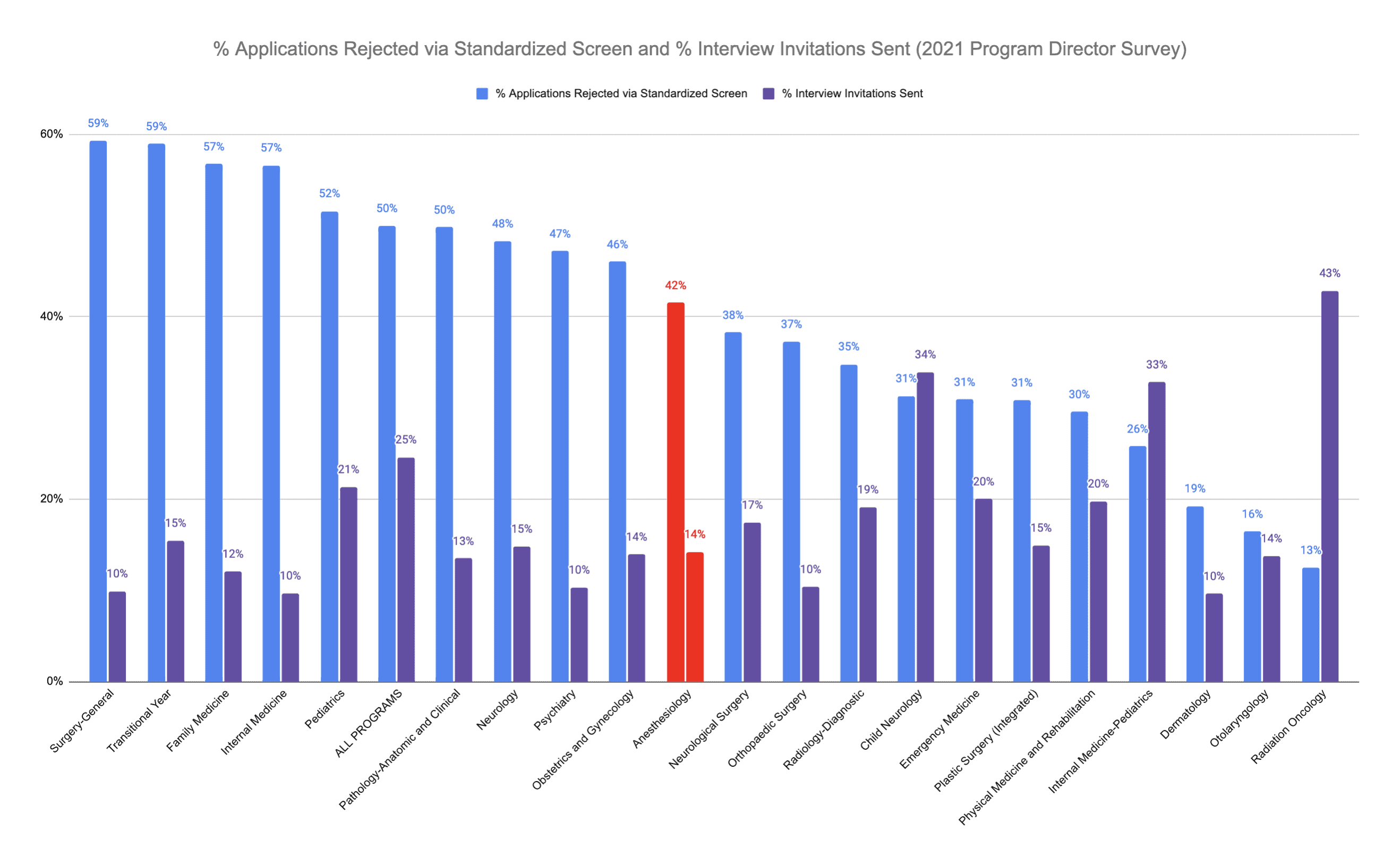
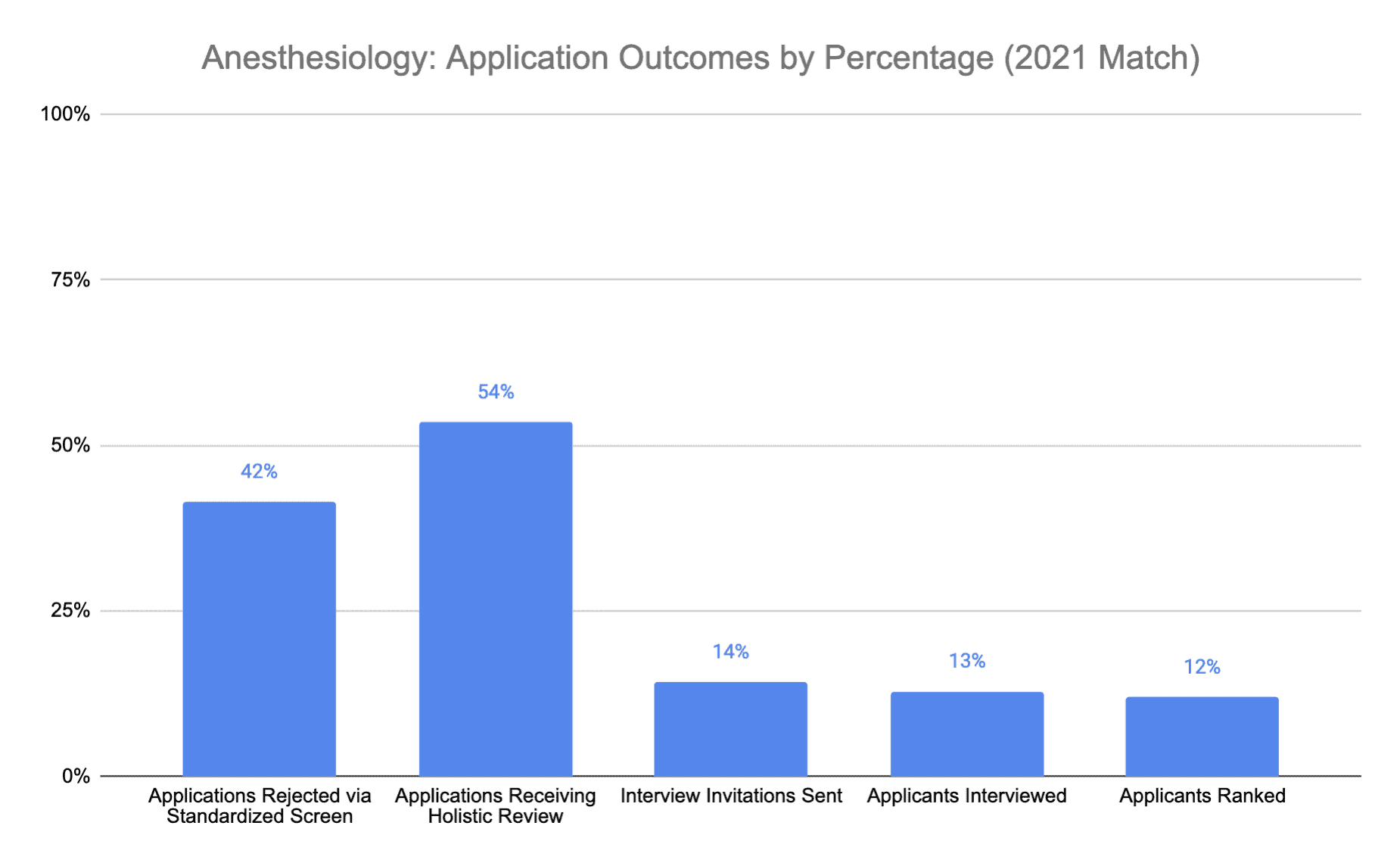
Anesthesiology relies on standardized screens to weed out applicants. In the 2021 Program Director Survey, anesthesiology PDs respondents reported that 42% of applications were rejected via standardized screen. This ranked near the middle of residencies.What Are the Step 1 and Step 2 CK Cut-Offs for Interviews in Anesthesiology?
As mentioned above, anesthesiology ranks near the middle of programs using standardized screens to eliminate applications. Many anesthesiology programs screen out applicants with failed USMLE Step 1 and Step 2 CK (see below). In addition, PDs use Step 1 and Step 2 CK score cut-offs to weed out applicants. For Step 1, anesthesiology program directors reported Step 1 score cut-offs between 208 and 220 as 25% and 75%ile marks to screen out applicants.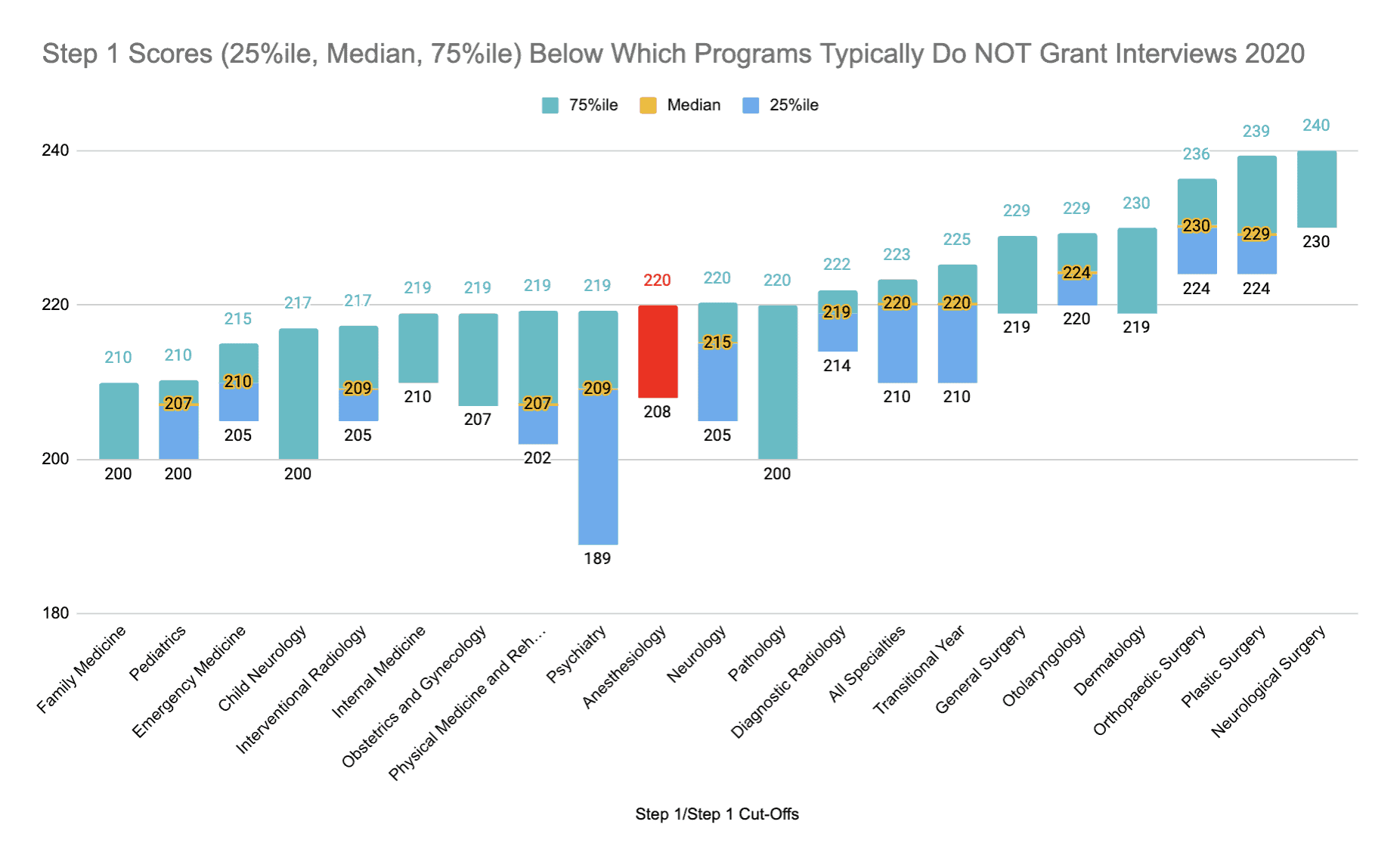 Similarly, anesthesiology program directors reported Step 2 CK scores between 220 and 230 as 25% and 75%ile cut-offs.
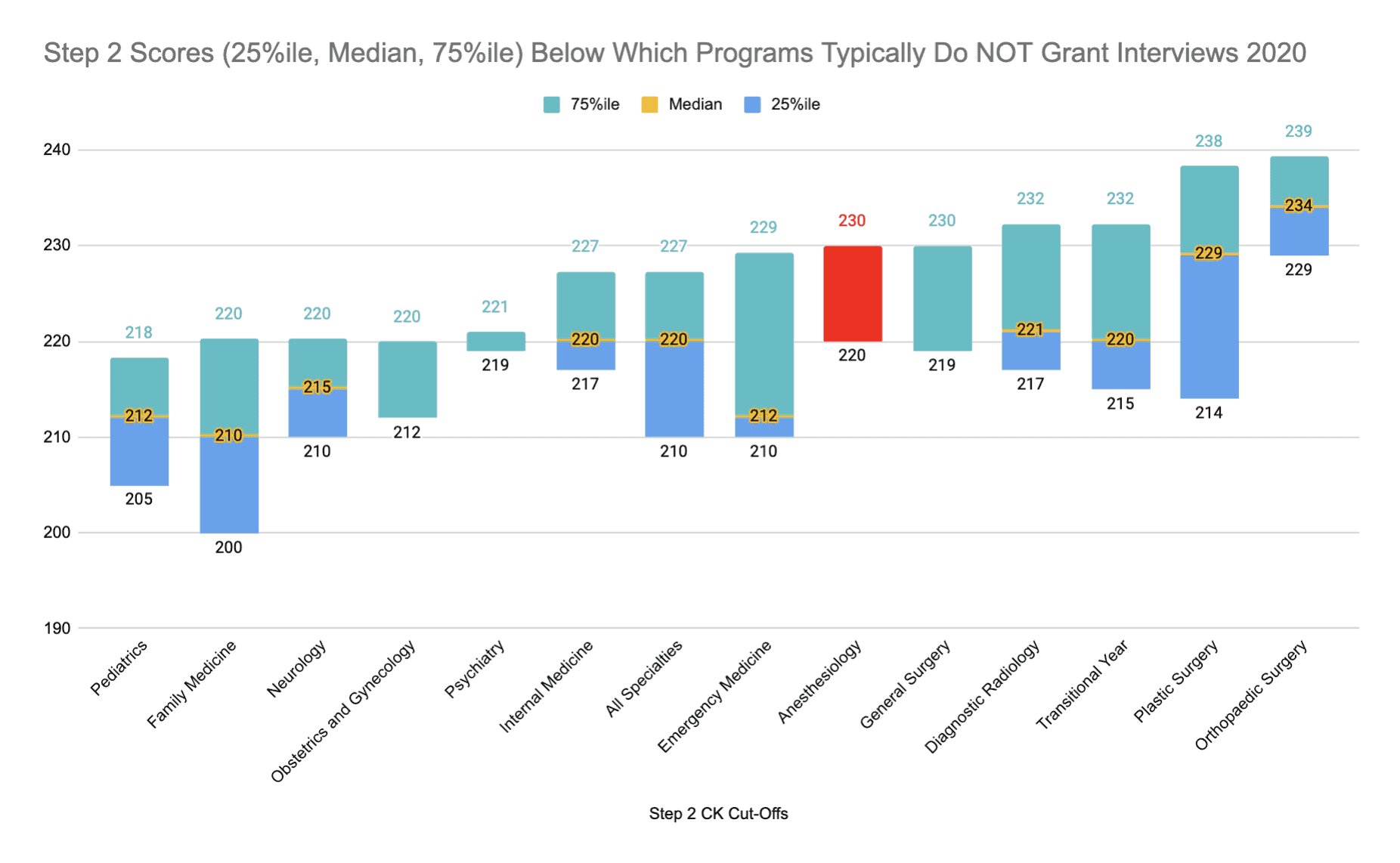 For more on the USMLE cut-off scores for granting interviews – or weeding out applicants – see this article.
If I Fail Step 1, Can I Still Match Into Anesthesiology?
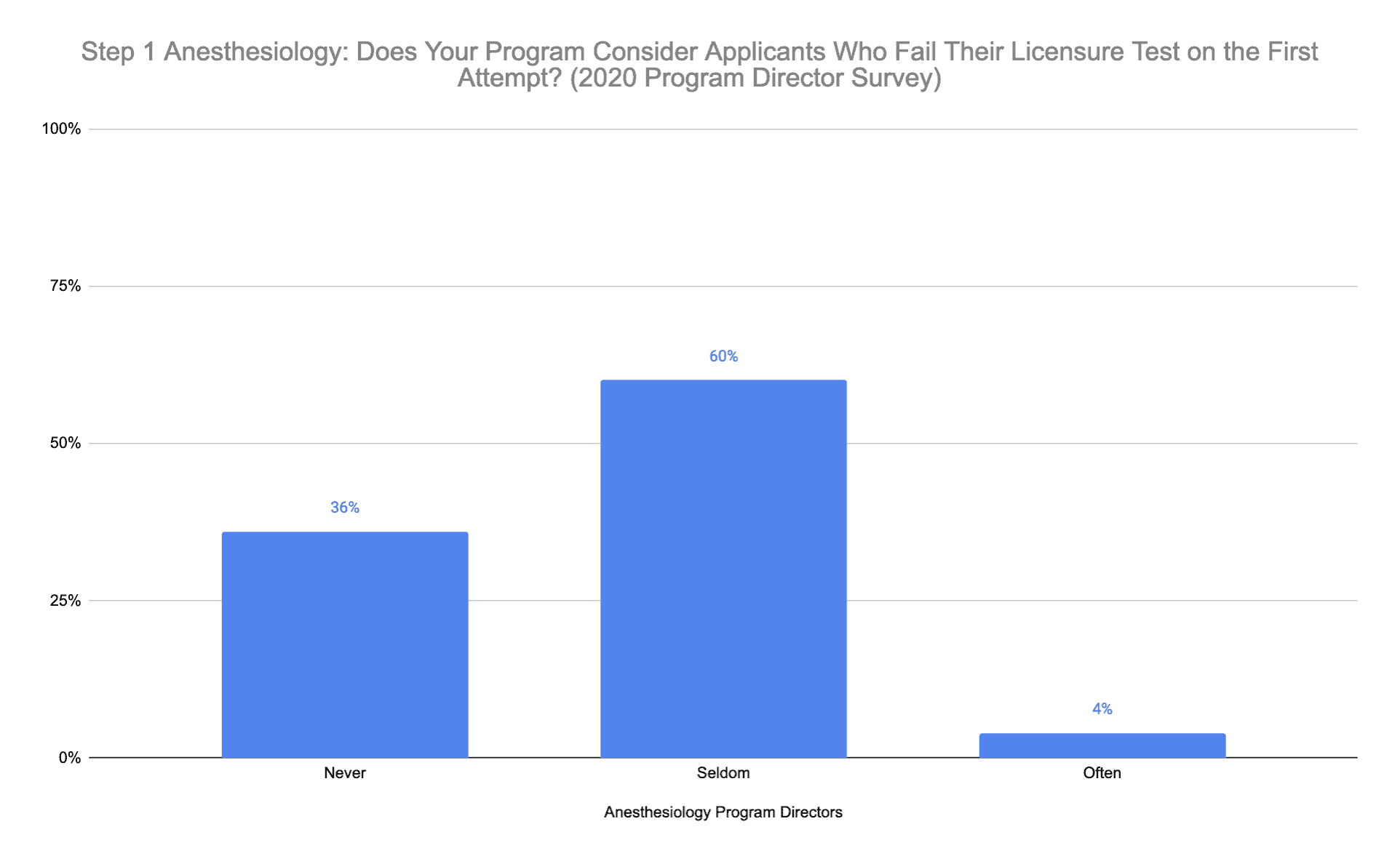
If you failed Step 1, you might wonder if you can still match into anesthesiology. In the most recent program director survey addressing this question, we can see that anesthesiology programs are relatively unforgiving if you’ve failed Step 1. In 2020, anesthesiology 36% of PDs reported they “never” consider applicants who fail Step 1, while 60% would “seldom” consider it. Only 4% of anesthesiology programs “often” consider someone with a Step 1 fail.If I Fail Step 2 CK, Can I Still Match Into Anesthesiology?
Similarly, you may wonder what your chances of matching into anesthesiology are if you fail Step 2 CK. Just like with Step 1, anesthesiology PDs are unforgiving for not passing Step 2 CK. In 2020, anesthesiology 40% of PDs reported they “never” consider applicants who fail Step 2 CK, while 56% would “seldom” consider it. Only 4% of anesthesiology programs “often” consider someone with a Step 2 CK fail.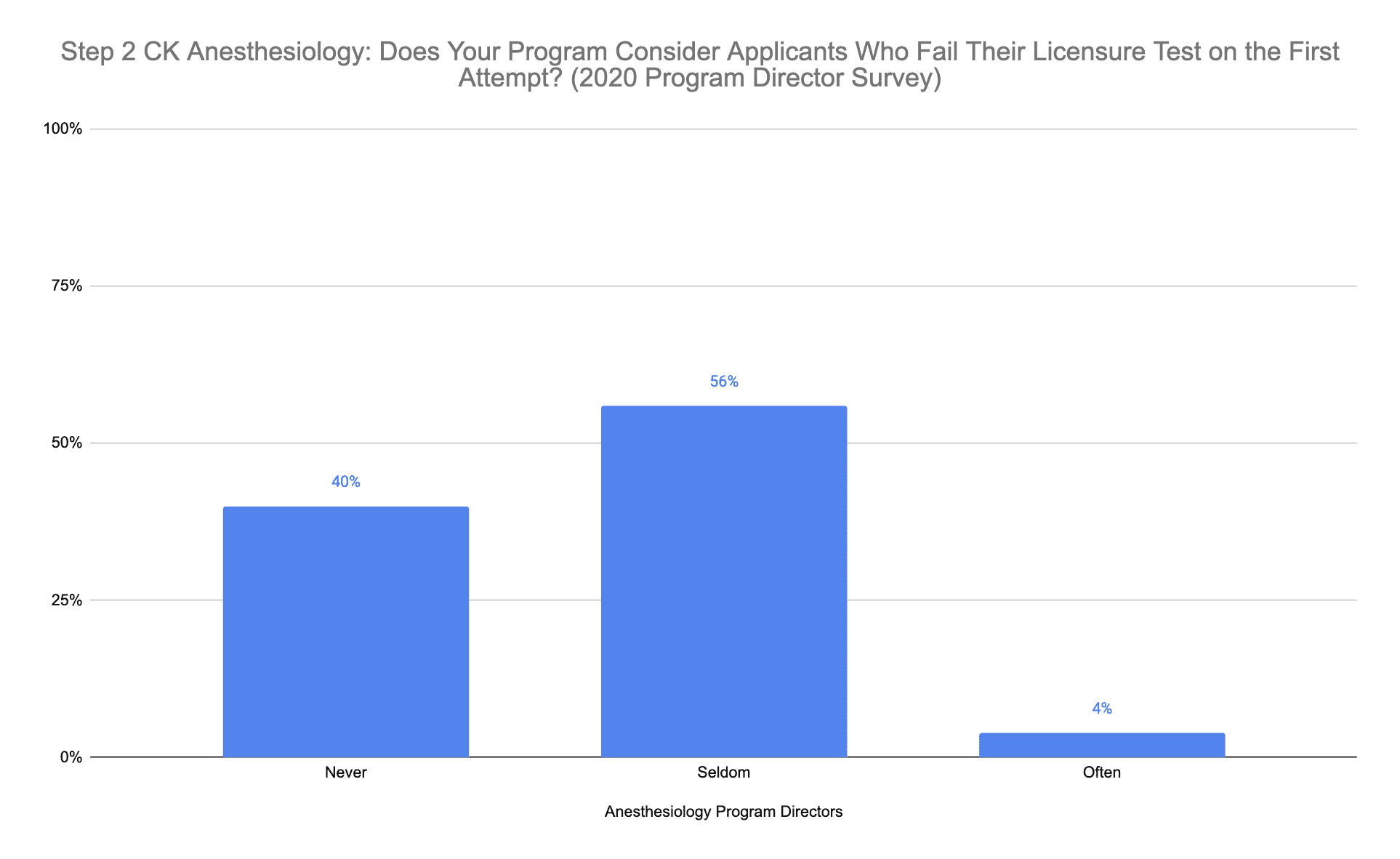 Did you fail Step 2 CK and wonder what you can do to recover? Read this article and consider scheduling a consultation.
How Many Publications for Anesthesiology Residency in 2022
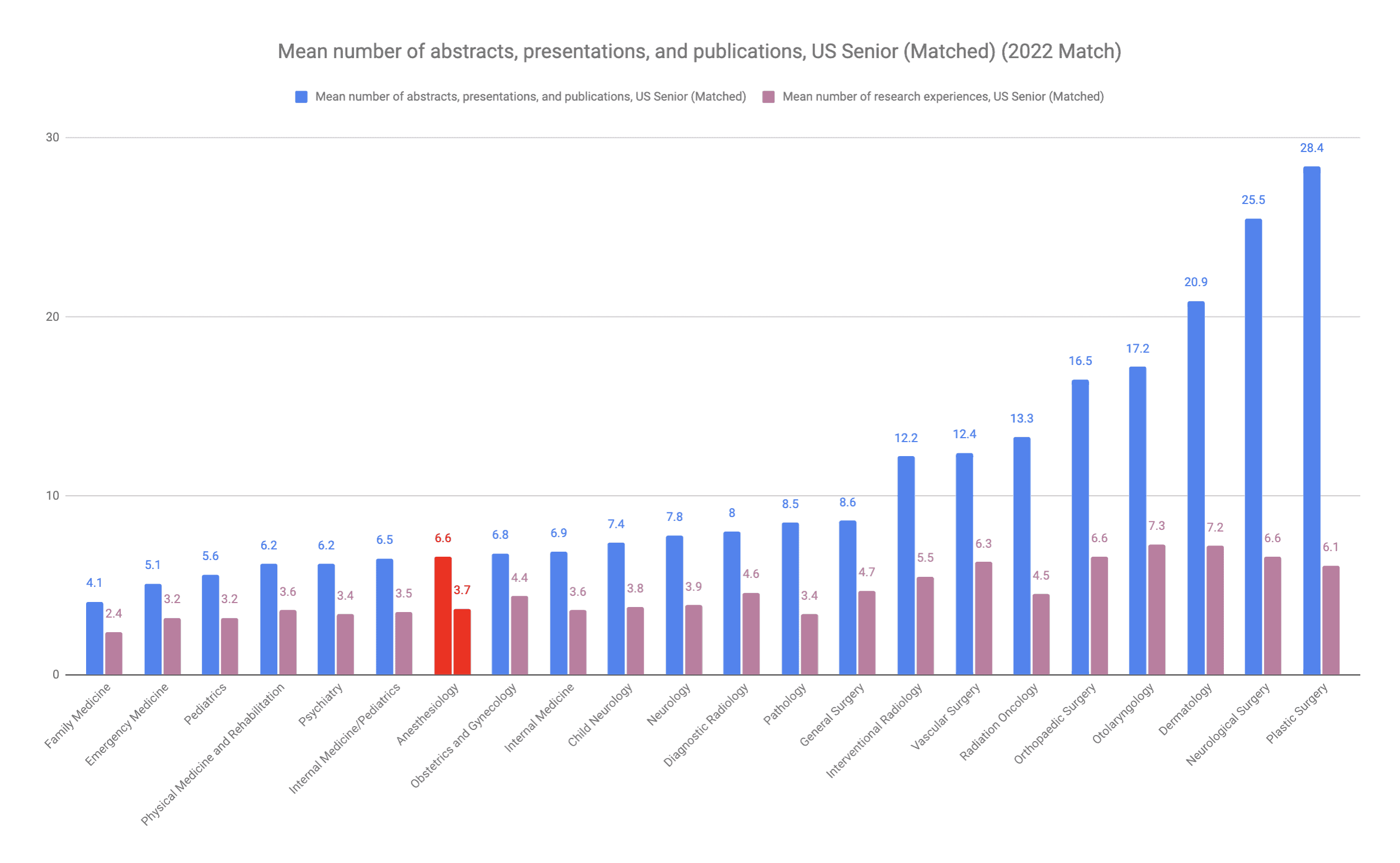
Research is an important characteristics for matching into many specialties, particularly the most competitive. So, how many publications do you need to match into an anesthesiology residency? In 2022, the mean number of abstracts, presentations, and publications for US seniors who matched into anesthesiology was 6.6. The mean number of research experiences was 3.7.Do I Need an MD-PhD to Become an Anesthesiologist?
You may wonder how much an MD-PhD helps with matching into anesthesiology. It appears that having a PhD correlates with a modest advantage of 5% when applying into anesthesiology. Specifically, the match rate for those with a PhD is 5% higher than for those without one when applying into anesthesiology.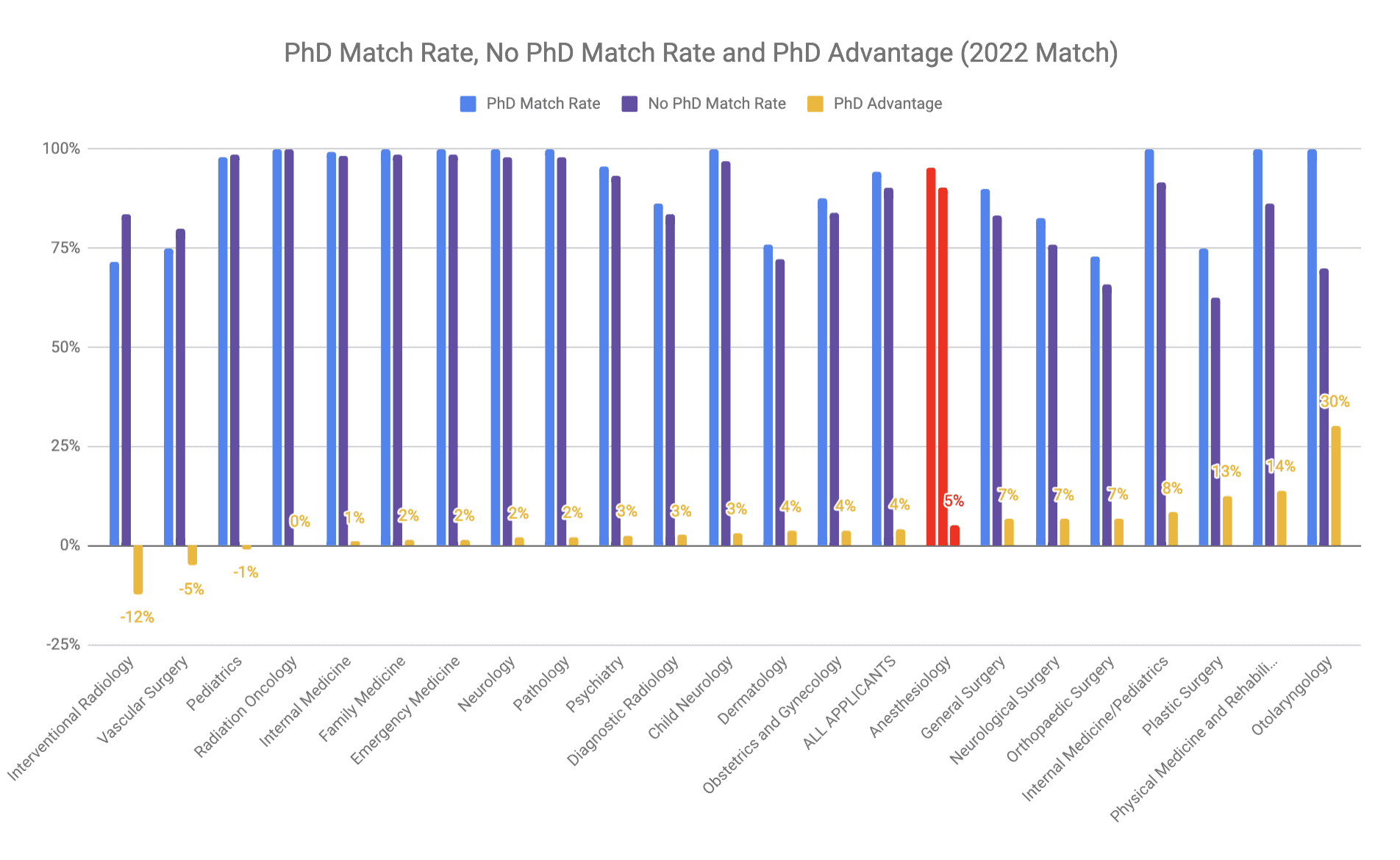
Having a PhD correlated with a 5% match rate advantage for anesthesiology in the 2022 Match
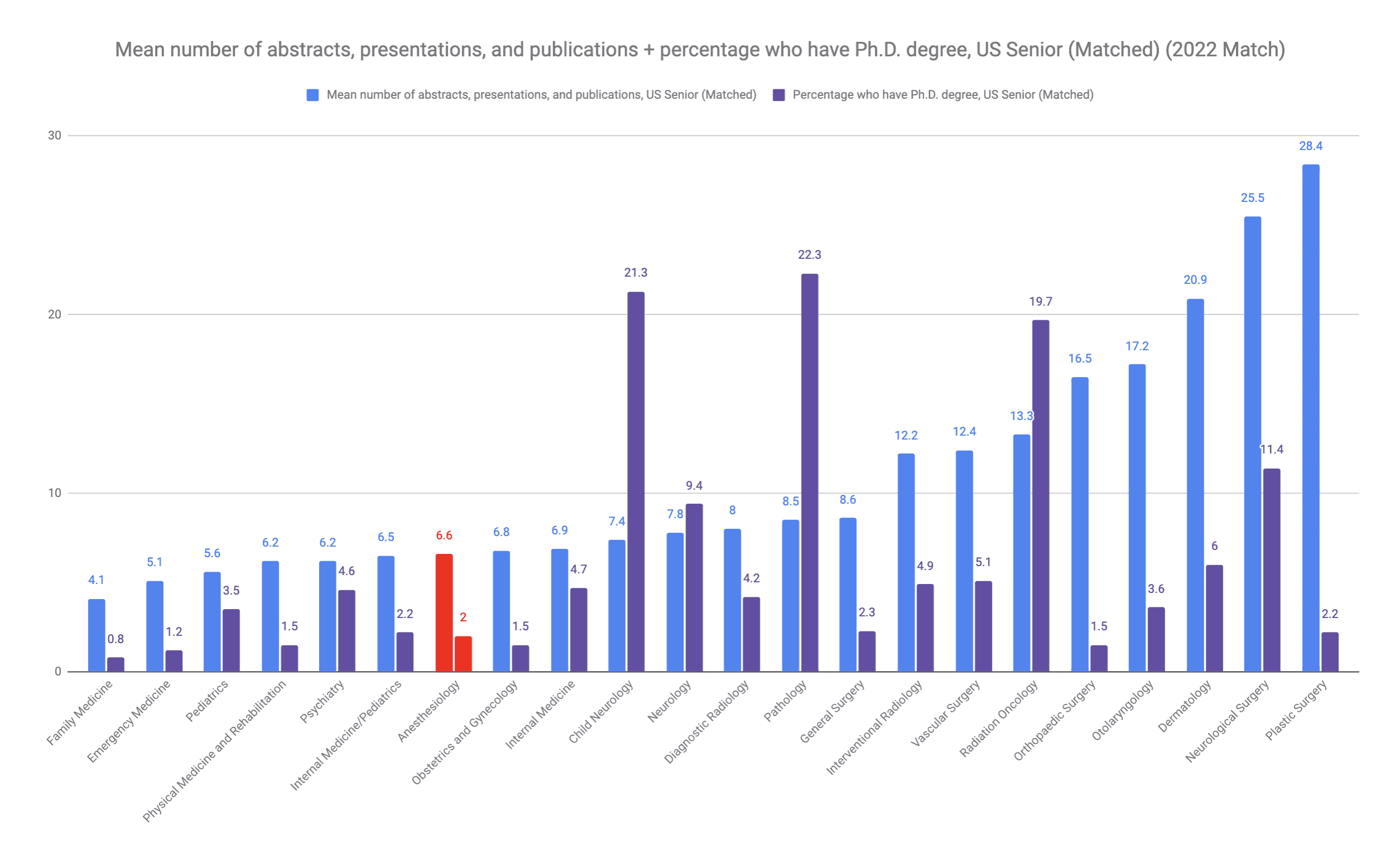
2% of matched applicants to anesthesiology had an MD-PhD in 2022
Anesthesia Residency Interviews
When you apply to anesthesiology, you may be wondering what the chances of getting an interview are. Here we present the outcomes of applicants per the 2021 NRMP Program Director Survey.When Are Anesthesia Residency Interview Invites Sent vs. Conducted?
When you apply to residency, you’ll be doing a lot of waiting. Specifically, you’ll be waiting to hear whether – and when – you will be able to interview. Want to know when you might expect to hear from anesthesiology programs re: your residency application? Here are when programs typically extend and conduct interviews. Note that the most recent data are from 2020.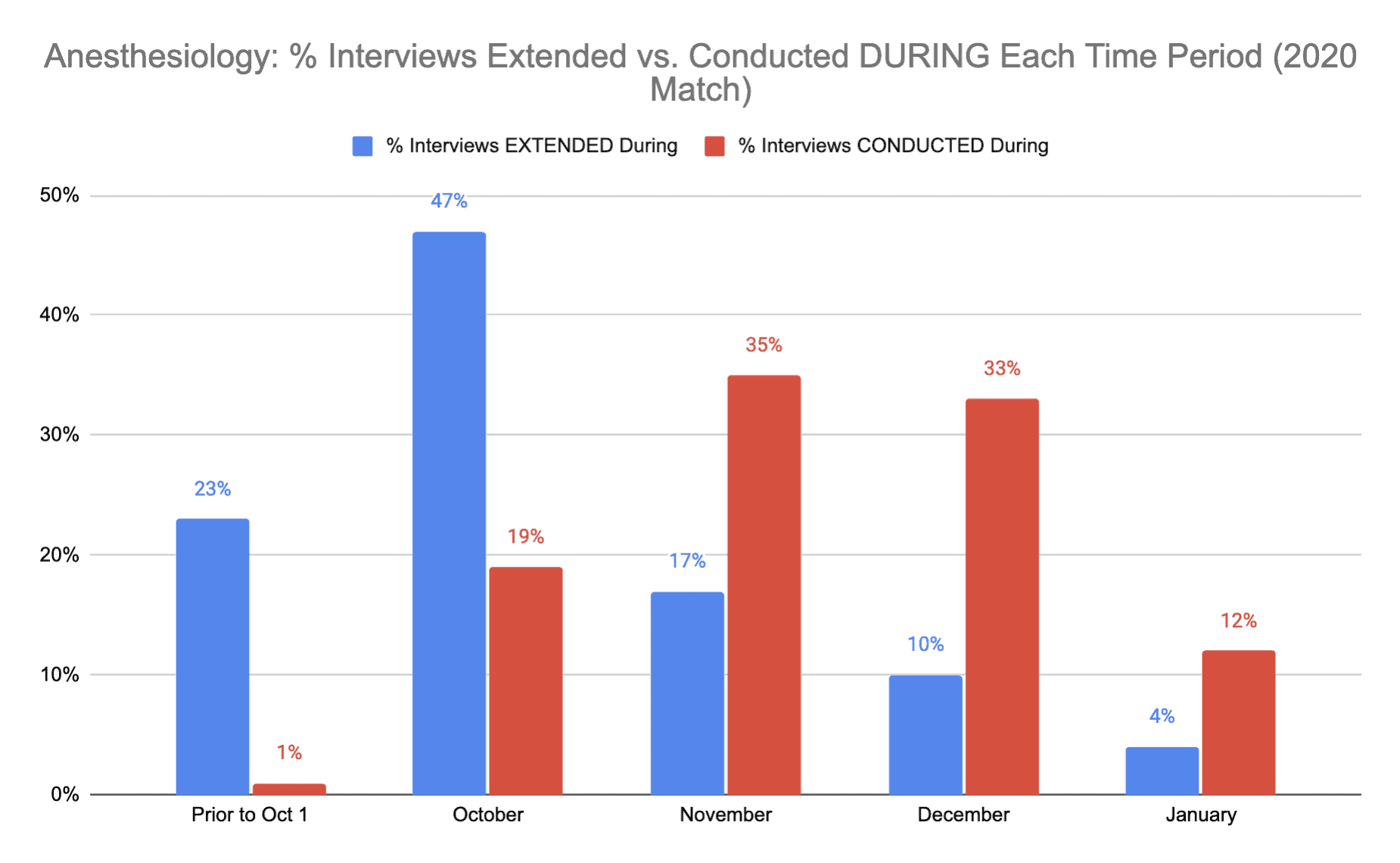 Here are the same data presented differently. Note that due to rounding, sometimes the percentages can add up to more than 100%.
How Many Interviews to Match in Anesthesia?
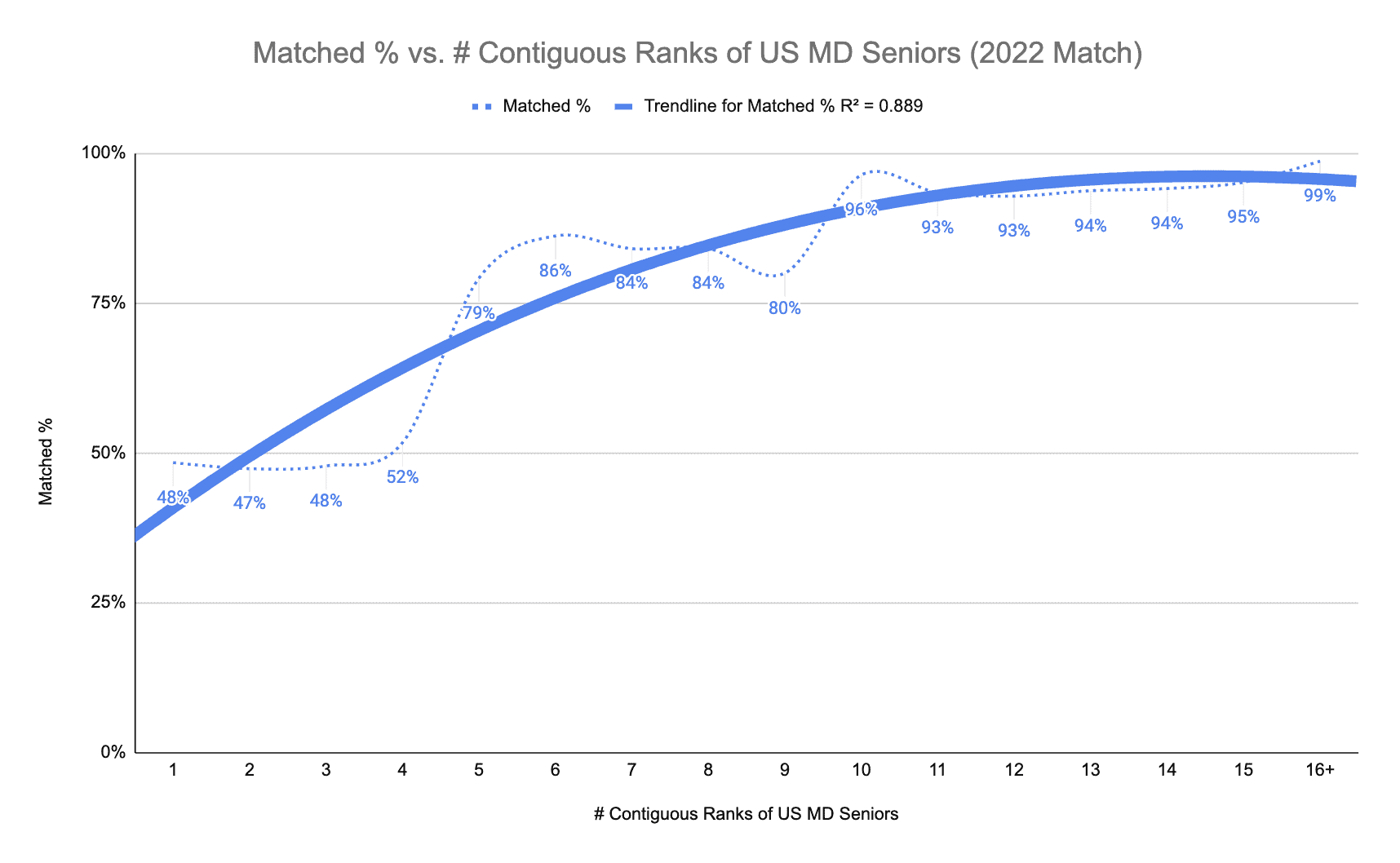
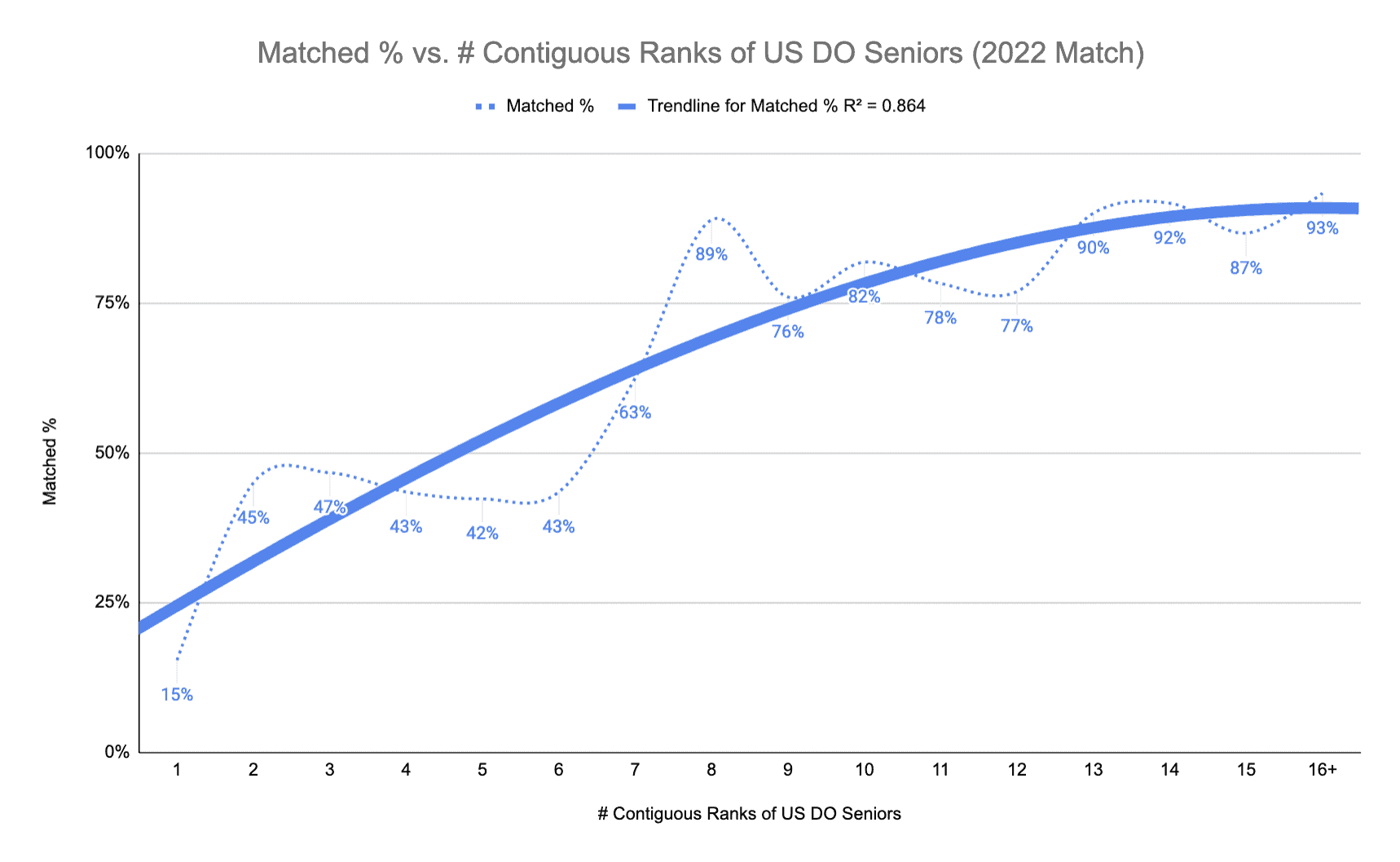
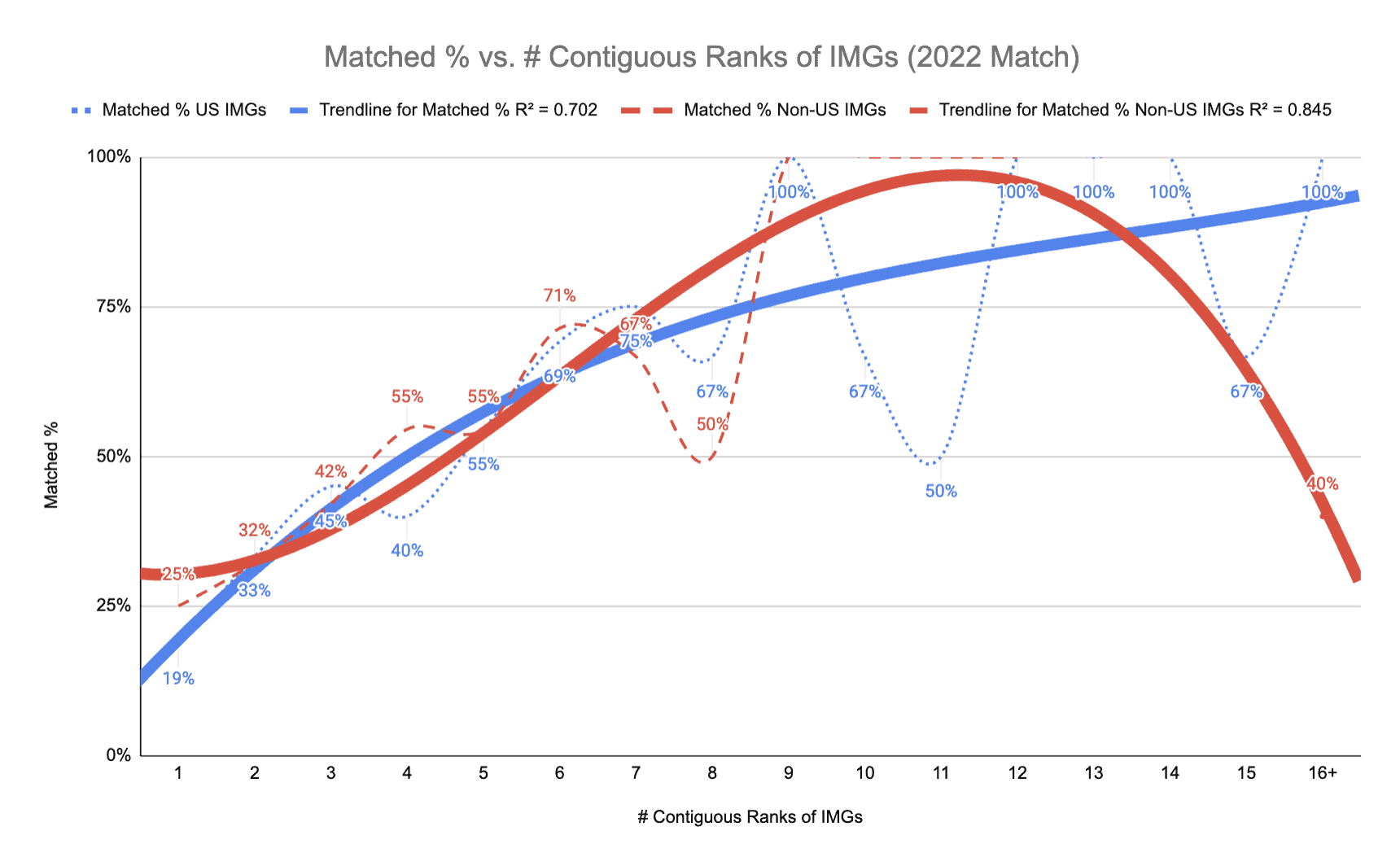
After applying to a program, applicants often wait anxiously to know whether they’ve received an interview invitation. Receiving – and attending – an interview allows applicants to “rank” that program on their match list. In other words, the more interviews you have, the more chances you have of matching into a given specialty. So how many interviews to match in anesthesia with confidence? For US Seniors, the magic number of interviews needed to match into anesthesia is 5-10. In 2022, having 5 interviews (and ranking them all on their match list) led to a 75-80% chance of matching. For even greater safety, though, having 10+ interviews led to a ≥93% chance of matching into anesthesiology for US seniors.